Posts

Showing posts with the label Jon Gordon

Team Tuesdays: Jon Gordon — The Energy Bus

Image
Would you call yourself an energy-giver or an energy-taker? In his book, “The Energy Bus,” Jon Gordon explains why having and sharing positive energy can be a game changer and difference maker. Success in any organization isn’t just about strategy — it’s about the energy we bring to the journey. Gordon’s framework challenges us to take full responsibility for our attitudes and actions. When we choose optimism over complaints or excuses, we stop being victims of our circumstances. For your team, this means two critical shifts: Fuel with Positivity: Negative energy acts as a drain on productivity. By focusing on solutions and maintaining a shared vision, you create an environment where enthusiasm becomes the most valuable asset. Protect the Culture: As Gordon famously says, "No Energy Vampires Allowed." A strong team culture requires boundaries. Focus your energy on those who share your mission and are committed to the ride. Ultimately, your team is only as strong as its c...
4.15 Jon Gordon: Be Positive

Image
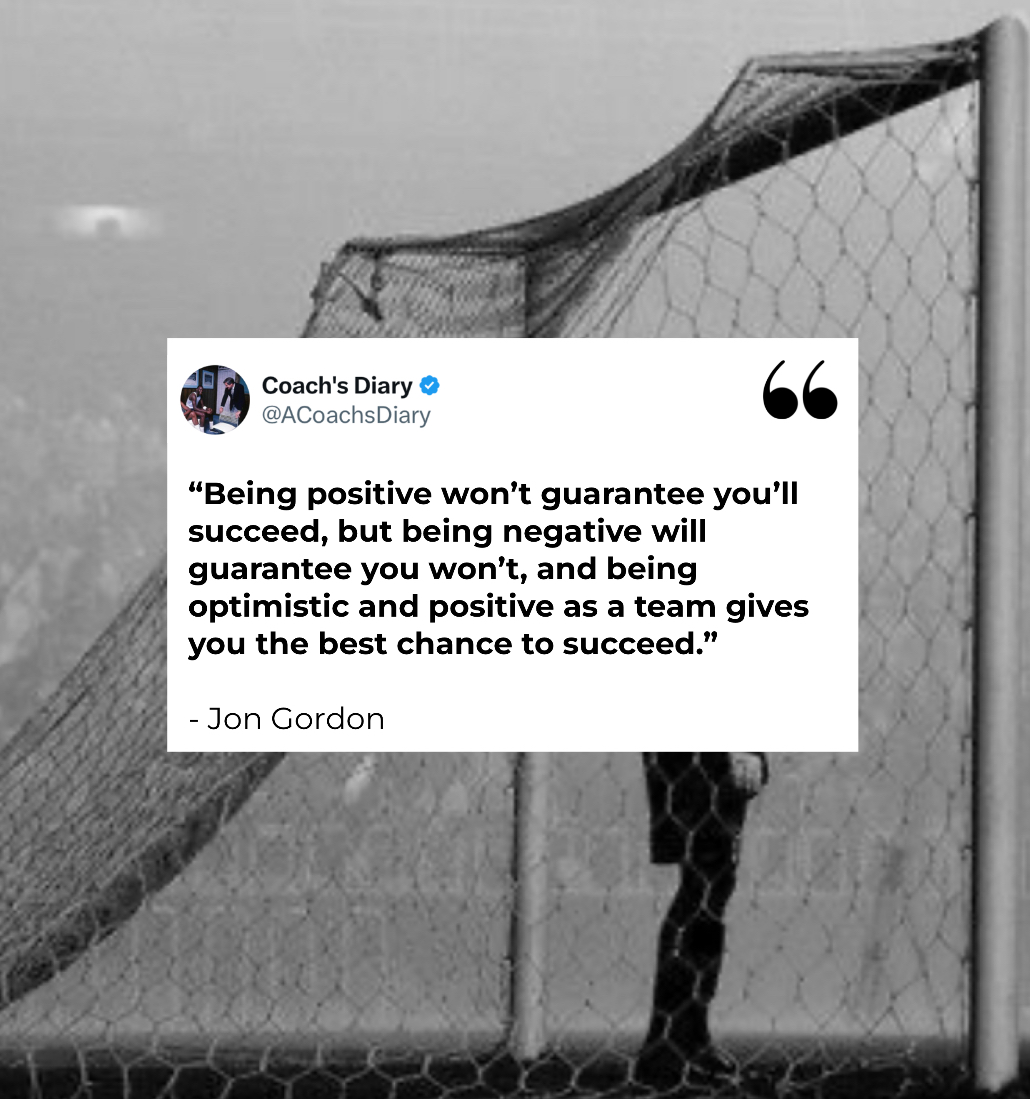
“Being positive won’t guarantee you’ll succeed, but being negative will guarantee you won’t.” - Jon Gordon Does negative energy ever slow you down or stop you from doing what you know you can? When a Division 1 coach was asked what he looked for in potential recruits, he said things like energy, demeanor, and the ability to do the little things are what stand out most, and he won’t recruit players who are too cool and don’t have the right mindset and attitude, no matter how talented they might be. He didn’t say anything about how many points they score, but how they play and how they impact their teammates and winning. Having positive energy is a difference maker. Author and speaker Jon Gordon talks to teams, coaches, and athletes about the power of positivity. He says, “Being positive won’t guarantee you’ll succeed, but being negative will guarantee you won’t, and being optimistic and positive as a team gives you the best chance to succeed.” Leading and responding with positivity can ...

Week Devo 33 | Pro Day

Image
NFL athlete and real estate agent Nick Ralston has an amazing story about how he made it to the NFL, and how his faith in God and hard work helped him overcome the obstacles in his life to make it to the best football league in the world. Nick was a star running back at Argyle High School (a small town west of Dallas) in Texas before going to play college football at Arizona State and Louisiana-Lafayette. At the end of his college career, he was in the middle of preparing for an NFL Pro Day in 2020 when the Covid pandemic hit and forced him to cancel his Pro Day, derailing all of his plans. His opportunity to work out in front of NFL teams was immediately ruined and taken away from him, and so were his NFL dreams. Instead of joining an NFL team, Nick moved to New York following a relationship that eventually didn't work out, and suddenly this former Texas high school football star was stuck in New York with no real options. He had every reason to give up on everything, but instead ...

Youth Sports Dads

Image
It’s hard trying to find the balance between pushing your kids and keeping sports fun. When you take the joy out of youth sports, it becomes a job and you run the risk of your kids not wanting to do it anymore. Jon Gordon and David Pollack had a great discussion about how to maintain that balance on Gordon’s Positive U podcast. Here are my notes: Don’t Make It Too Serious Too Early Don’t professionalize sports for kids, and don’t over-prioritize sports too early. There is plenty of time to get serious.  Don’t make it too serious too early or you run the risk of burning them out. Keep it fun and keep it healthy because the journey is a marathon and not a sprint. Character >>> Results Don’t worry too much about outcomes; worry more about who they are becoming as a result of the chase. The purpose of sports is to make you a better human being. Focus on that. At some point, we will all be retired athletes; who will you be when you are finished playing? Keep it Fun and Healthy ...

Positive Energy

Image
In his book Uncommon Leadership , Ben Newman wrote, "Positive energy is like a muscle. The more you use it, the stronger it gets. The stronger it gets, the more powerful you become. Repetition is the key, and the more you focus on positive energy, the more it becomes your natural state." Leadership can be a tricky thing. He writes that Jon Gordon's definition of leadership is that leadership is a transferred belief that combines passion and energy to transform the people around you. The tricky part about leadership is that you can be in a leadership position, but you must always remember that people choose to let you lead them, and they are always free to walk away. The higher we move up in our leadership roles, and the more people we lead, the more you must serve the people below you. You have to give them a reason to want to follow you. You must help them get better, enjoy what they do, and see how following you can help them learn and grow into the person and life that...

Stay the Course, Keep Showing Up, Sow Seeds

You ever feel like you are terrible at something? Do you ever feel like you can't catch a break and you will never catch a break? I felt like that this morning, and I am still feeling some of that, but I recently heard a Jon Gordon podcast featuring Scott Harrison, the CEO of charity: water, and it gives me some hope. About 15 years ago, Scott turned his full attention to the global water cross and the (then) 1.1 billion people living without access to clean water. Fourteen years later, his charity has raised over $557 million and funded over 78,000 water projects in 29 countries, and it has provided over 13 million people with clean, safe drinking water. Scott told three stories in his podcast about grit and perseverance that are giving me hope to keep going, and I hope it gives you hope as well. STAY THE COURSE Scott said that he saw a Tweet of the stock chart of Amazon's price over 27 years. It looks like a flat line for 20 years, and then it turned into a hockey stick. The ...

The Game Day Principle

Image
"But coach, I can't run because I hurt my wrist." I once coached a kid, let's call him Taylor, who was very injury-prone. It felt like each week during the pre-season, he was hurting something, and Taylor was starting to spend as much time in the training room as he was on the court. This was happening before practice officially started for high school basketball in Texas, but we were able to do strength and conditioning before school to get their bodies prepared for the season, and we were able to do skills training and scrimmage during our period. Taylor had a lot of potential, and he had a legit chance to make the varsity team as a sophomore and play meaningful minutes, but the injuries were hurting his chances. Injuries can be difficult to manage as a high school coach, especially during the grind of the off-season. On one hand, we want to honor the injuries and make sure that we do what we can to keep our athletes healthy. On the other hand, we had to figure out ...

Jason Preston | Confidence and Mindset Will Take You a Long Way

Image
Jason Preston was just drafted by the LA Clippers, but he wasn't a top recruit nor a star on his high school team. He only averaged 2 points per game in high school, and he was on the "C" team in prep school without any college offers. He made his own highlight tape and received an offer from Ohio University. Jason put himself on the national radar after scoring 31 points against Illinois, who was ranked #8 in the country, and now he is preparing for a career in the NBA. Jason is not the prototypical draft pick, but he said he is not surprised that he has made it to the NBA. Jason said that he dreamed of this and he worked for this. Jon Gordon asked him, "What would you tell kids who have a dream but it isn't looking good right now?" "Believe in yourself. You will have a lot of people tell you what they think you should do, but they can't live your life. You have to do what is best for you. That comes down to how you believe in yourself. You will be...

4 Questions

Image
Great teams are teams that have coaches who are truth-tellers and players who can listen, take coaching and criticism, and use it to help them be and play better. There is a team in Texas that was known for having a lot of talent, but they were never able to put it all together to create successful, winning seasons. When they were on, they were on. But when adversity hit, they would start to fight with each other by pointing fingers and blaming others for mistakes. Coach Rod was ready for a change, so he read Jon Gordon's book, the Power of a Positive Team. Toward the end of the book, a story about Pete Caroll and his time coaching the USC football team stood out and inspired him. When Carroll was at USC, the Trojans enjoyed an amazing run of success that included a record of 97-19 and winning the 2003 and 2004 AP National Championships. Carroll created "Tell-The-Truth Mondays." The team would get together on Monday's after their game and talk about what they did wron...

Thieves and Allies

There are two types of people: thieves and allies. Thieves steal your time, energy, joy, and dreams. Allies are people who fill you up and make you better. Look at the people that you spend most of your time with. Do you spend more time with thieves or allies? Do the people you hang around have the same goals as you? Are they good role models? Do they make you better? Antonio Neves is an author and speaker, and he told a story about his time as a walk-on college track athlete at Western Michigan. Being a walk-on can be tough. You aren't guaranteed a spot on the team, you don't have a scholarship, and you can be cut at any moment. Every single day, you have to show up ready to work, give your best, and bring value to the team to earn your stay. He said that one conversation with his head coach completely changed his life. The coach said to him, "Antonio, you are doing horrible. In the two years that you have been on the team, not once have I seen you spend any time with ou...

Teams Beat Talent When Talent Isn't a Team

Image
A connected team is a more committed team. The more connected you are to each other, and the more committed you are to each other, the more you will fight for each other and not with each other. There is a great quote that says, "Hard work beats talent when talent doesn't work hard." There is another great quote that says, "Teams beat talent when talent isn't a team." One thing that every coach and every athlete, especially the leaders of the team, can do is work hard to connect with their teammates. The best teams are connected and work together. The best teams become a family. I often say that you have to catch the fish before you can clean it. This means that you have to connect with and build relationships with your teammates before you can lead them. Connection doesn't happen by accident. You have to connect on purpose. You have to invest in relationships and team building, and you have to invest in it every day. Think about how you talk to your tea...

Sitting In Your Car Is Self-Care

Image
Do you ever just sit in your car before going into the house, tired, stress, frustrated, or angry? I have had many of these days, and it seems like those little moments sitting in the driveway with the car running brings me some peace and restoration before going into the house to my most important jobs of being a husband and a dad. After listening to a recent Jon Gordon podcast , I realize that there might be some real benefit to sitting in the car for a few minutes before going in and that it can be a very beneficial form of self-care. Coaching is a tough profession. We pour into and feed into our athletes and their families so much that it is easy to come home feeling depleted, and we often bring our worst home to our own kids and families. We give everyone our best and we give our families whatever little is left. Jon said that we have to make our home team is just as important as our work team, and we have to bring our best self home. He said that the key is to know that most argu...

The Ratio of Positivity

Image
In the book, The No Complaining Rule, by Jon Gordon, it talks about the importance of having purposeful, positive interactions with your team. Teams and people are more successful and effective when they are positive, but a lot of us don't have ingrained positive habits, positive actions, and positive thinking in our lives. A positive culture doesn't happen through osmosis. It happens by relentlessly focusing on curating a positive culture and weeding out negativity. The best way to deal with negativity is to create a positive culture where negativity can't breed and grow and survive. Otherwise, you will spend all of your time fighting negativity. Anytime there is a break in communication, leadership, or expectations, it creates a space where negativity can grow. We need intentional, positive leadership, we need positive interactions, and we need positive communication to fill the voids so that negativity can't breed. With my teams and with my family I try to remember ...

Thinking Partners

Image
Coach Mike Bayer works in mental health and personal development. He recently spoke to Jon Gordon on his Positive University Podcast about the benefits of having a 'Think Partner.' "Whenever we are evolving, the world around us shifts a little bit. Whether we are evolving in our relationships, or have kids, or a new job. For me, I love having a thinking partner to talk about it with. Someone else can really point out those blind spots in us. Mike went on to talk about his relationship with Dr. Phil. He is a regular on Dr. Phil's show, and he talked about how Dr. Phil has been a Thinking Partner for him and a mentor: "We normally go to lunch all of the time; at least once a week. Usually, I bring ideas to him and we start riffing. Even the first time I was going on television for my last book, I went to his house and I gave him my pitch, and he would coach me on how to do it, what to say, and thinking about who I am talking too. It has been an amazing m...

Dealing With Failure

Image
I once coached a kid who was a perfectionist. She was the prototypical oldest child. Type A personality, high achiever, and super competitive. What made her so good was that she really, really wanted to do the best she could for herself and others. She wanted to compete, she was super coachable, and she wanted to please. All of those characteristics also manifested itself in one negative way: she struggled mentally when she wasn't able to master something quickly. It started out simple and harmless, but her inability to handle adversity began to get worse and worse. I started to notice that with every mistake, she would look immediately to me. Then she started to look at her parents after each mistake. I set up a meeting with her parents to talk about this. My biggest goal for her was to learn how to play through mistakes and learn how to deal with adversity appropriately. This was a life skill that we needed her to learn. The last thing that we wanted was sports, and ou...

The No Complaining Rule

Image
When I was playing college basketball, I hated early morning workouts.  Every Friday in the pre-season we had a track workout, and the day before, we would have a team vote on whether we would prefer to workout in the morning before classes or wait until after classes. Almost every time, my team would vote to workout in the morning, and every time I would groan. One day, my coach called me out on it.  He asked me to find something positive to say next time instead of complaining.  When I would groan, it would bring down the energy in the room and have a negative effect on our energy.  My words impacted the energy in the room and it impacted our workouts. I started to fake being positive about the early morning workouts, and it actually started to improve my attitude, my mood, and my work ethic. I went from faking excitement to being motivated, to attacking our workouts. The point of training and working out is so that we can improve and beco...
Image
UCLA football coach Chip Kelly met with Jon Gordon for an interview.  Below are some of my notes from the podcast. ..... Create an environment where your players have an opportunity to be successful, then get out of their way and let them do what they do best. Arm your athletes with the tools they need, play to their strengths, and give them the freedom to do what they do best. ..... Be teachable. Be coachable. Have an internal desire to be better tomorrow than you are today. Become the best version of yourself. Want to be your best. Want to excel. Have a desire to get better and excel. Want to get better every, single, day. ..... The difference between being good and being great is the size of your desire and what you are willing to sacrifice to be great. Is your desire for mission accomplishment greater than you desire for personal comfort? People that want to be great know that you are going to have to make sacrifices and they know what ...

Great Teams and Motivating Athletes

Image
Great teams, families, classrooms, schools, and organizations share a lot of the same principles and have similar values.           "Link:  Jon Gordon joins MTTS to talk about motivating athletes" Great groups have a shared   vision and  purpose , they stay positive through challenges, they don't allow negativity to sabotage the group, and they work to build great relationships so that they have stronger connections and a stronger team.   Great groups have grit .  They have consistency .  They have mental toughness . Great groups are like craftsmen - people who pursue excellence in their craft.   Great groups put ' we before me .'  They serve their teammates.  When you serve your team, they get better and you get better.  When you help them improve, you improve. It's important to learn how to get through the tough moments and how to perform at your high...

Todd Durkin and Jon Gordon

Image
Todd Durkin is a professional trainer who got his big break training NFL MVPs LaDainian Tomlinson and Drew Brees when they were young players just getting started in the NFL. Jon Gordon asked him, 'How do you help some of the greatest athletes in the world get better?' Here was his response: Every great coach tells their athletes what they NEED to hear, not what they WANT to hear.  They hold their athletes accountable, the motivate them and start a fire within them. Coaches provide accountability, the know-how, and the ability to inspire their athletes to get to the next level. Our job is to tap into the spirit inside of them.  It is to tap into the mind, the body, the spirit, and the soul on every level, and ask, 'What can I do to get them better and to the next level?' Todd was then asked,  "What are some key principles that guide you?" "You have to care about your athletes.  Care more and above and beyond the training and the s...