Posts

We Have to Lead Ourselves

Image
The most important part of being a leader and a coach?  You have to first learn how to lead and coach yourself.  You have to model how to bring energy and enthusiasm - everyday - whether you 'feel' like it or not.  We ask our players to leave their problems in the locker room and stay focused between the lines.  We have to be able to do the same and be completely invested and locked in on them and for them. We have to hold ourselves accountable.  We have to be life-long learners and find ways to learn, grow and get better.  We want our athletes to work on their game outside of practice, we want them to come early and stay late, and we want them put the extra work in to be great.  We have to be willing to do the same.  We have to be ready to learn and get better at what we do.  We have to make sure that we are willing to come early and stay late and we have to encourage it and push for the extra effort that we want. We have to ...

Think Gold, Live Gold

Image
What we call ‘elite’ at 8 years old or even at 14 years old and going into high school is a basic requirement at 18 when it really matters.   Being considered ‘the best’ carries an expiration date, and it expires when your peers’ game, skill, and ability out-grows your own.   The only way to push back that expiration date and to stay on top is to continue to work on your game, continue to listen to your coaches, parents, and anyone who can help you improve, and always find ways to get better.   The second you stop getting better is the second somebody will pass you up. This is what ‘the process’ is, and your character drives the process.   To become the best that you can be, you have to work as hard and as smart as you can work.   In A Champion’s Mind , author Jim Afremow says that we if we want to become the best that we can become, we should live by ‘Gold Medal Standards.’   Winning the gold medal in any sport means that you are the best at what...

My Kids Are Better People Because You Coached Them

Image
I heard a superintendent tell a group of coaches this last week.  It had to have been one of the best compliments that a coach can hear, especially coming from a boss.  In a world where parent complaints and transfer rates are seemingly at all time highs, and when every other week we see articles where coaches either resign or are fired because of parent issues, hearing your superintendent say something like this has to be a reassuring and rewarding gesture. Having a parent genuinely feel this way about the time that I spent with their athlete is one of my ultimate goals as a coach.  I want them to feel like I helped their kid become a better athlete and a better person, and I would love for them to be grateful and appreciative of the time and energy that I gave to their athlete. But how do we get to this point?   It starts with focusing on growing our athletes and helping them become the best people and athletes that they can be, and we ...

You Have A Systems Problem, Not a People Problem

Image
When you find yourself frustrated about what your players can't or aren't doing, ask yourself, 'What are our process or system for monitoring, improving, emphasizing, or correcting this performance or behavior?' 'My players aren't motivated.' - What is our process for getting players excited about practice or what is your process for creating goals that keep your kids focused and dedicated? 'My players won't come in a get shots up on their own.' - What is an effective way/system for getting players in the gym outside of practice? 'My players don't know 'how' to work on their game at game speed on their own.' - When they are with you, what are some effective things that we can teach them that they can do on their own? '_____ is acting up in Algebra class and _____ is failing biology.' -  What is our weekly process of monitoring classroom grades and behaviors? It is frustrating when I can't get my pla...

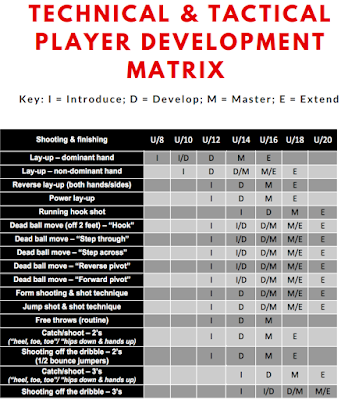
Werribee Basketball Holistic Curriculum

Image
Werribee basketball is a program in Australia's Melbourne West.  One of their coaches posted this to a website on Facebook regarding their club's holistic curriculum from last season.  It is really good, as it is a developmental program for their athletes from the youth, u8 level to the u18 levels. Below is a link to their program.  I really like the age group points of emphasis (40-47) and player development matrix (48-56). http://werribeebasketball.com/wp-content/uploads/2017/11/Werribee-Way-Curriculum.pdf?fbclid=IwAR1Npg-9BKCfF98eYQ5sVZLkN5vt9P8edaVVeqenjl2WzipK1AH0xATuMJg https://drive.google.com/file/d/1aAuR33naFV4M79u3aZEAskzrkaGiIiXu/view?usp=sharing

Internal vs External | Intrinsic vs Extrinsic

Image
"Two big reasons I work with students to set internal goals is that I want to cultivate in them an “internal locus of control.” I want them to believe that success is within their reach, and that personal, internal goals are more satisfying than external ones. When they do, they also experience more peace of mind. So, as you mentor your students, let me suggest the following: 1 - Have your students write down their goals for this year. 2 - Help them evaluate whether their goa ls are more external or internal. 3 - Coach them to re-write any external goals, converting them into internal ones. Not only will these goals be more rewarding, but they might just help those students decrease their anxiety. I’d call that a double-win. Jean Twenge’s theory suggests that increases in anxiety and depression we see today are connected to the shift from “intrinsic” to “extrinsic” goals in students. Intrinsic goals are ones that deal with one’s own development as a person, such as bec...

Here’s What It’s Like to Be an Olympic Mental Skills Coach

The following article is from Self.com.  I am fascinated with the world of mental-performance and how our minds can and are a separator for success.  I am in no way trying to profit from this article, but find it to be a valuable resource in my own growth and understanding of how to get the most of the athletes that I work with. Olympic athletes  push their bodies to the limit. From the outside, it seems that they develop this ability through dedicated training regimens and long days practicing and  perfecting their sport-specific skills . Which, of course, they do. But being an elite athlete is not just a physical feat. To perform at the top of their game, professional athletes spend time training their brains, too. “There's not an athlete or team, either Olympic or professional, that’s not utilizing the services and expertise of a mental skills coach,”  Colleen Hacker, Ph.D. , a five-time Olympic Games coach who currently serves as the mental skills...